




Keyword:  
Perform Case Matching
Wildlife in High Desert
 

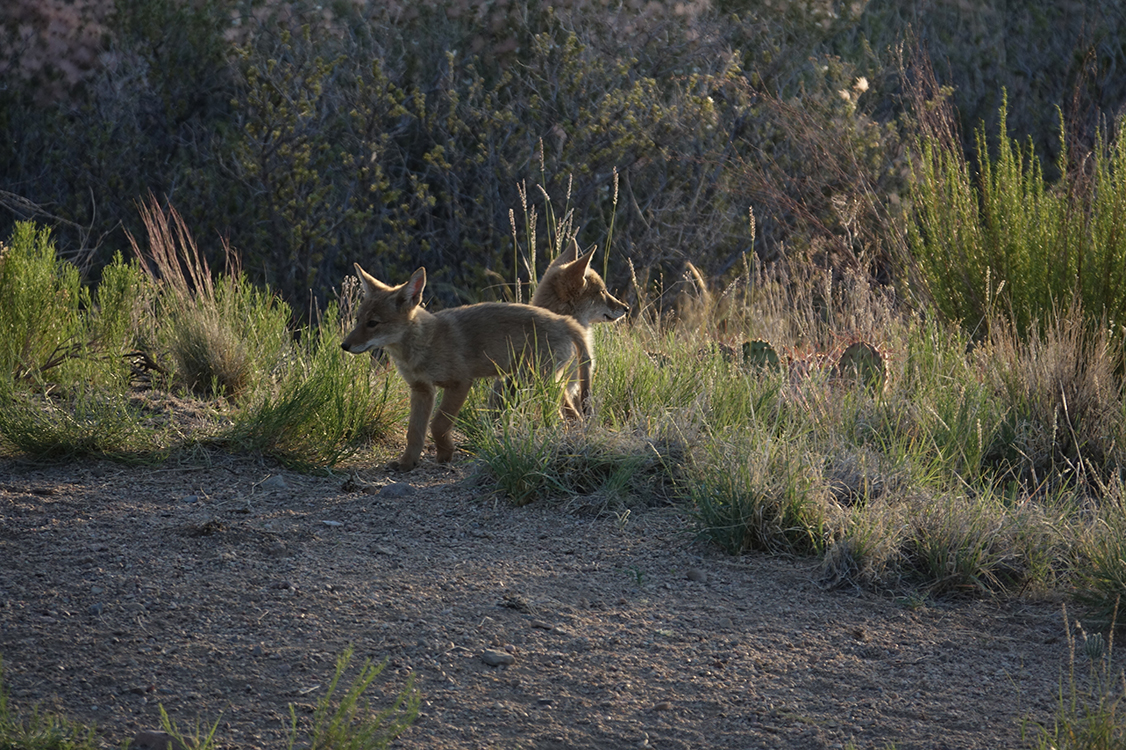
High Desert Coyotes


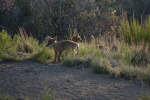
This photo of a coyote was taken by High Desert resident Randy Rosett from his yard in the Highlands.  

Randy's property backs up against Open Space and he often sees wildlife out his back door. This photo was taken with his Canon PowerShot.


Great Horned Owl Visits High Desert
December 2008

This owl is no plastic decoy--it's the real thing.  Trillium resident Bill Velasquez captured this startling photo after spotting the owl on his neighbor's roof. Here is how he described the encounter:


We were on our front balcony Christmas Eve around 10 p.m. enjoying the luminariaseating smoked cheese, and sipping Pinot.  All of sudden, out of the corner of my eye, I saw a flutter that looked like a bat coming out of a cave.  

I looked up to our neighbor's nearby rooftop and to my amazement there, perched on the edge,  was an owl barely visible against the black of the night.   I wondered what chance I had to rush down the stairs, grab the camera and steal a picture.   It was worth a shot.   

Off I scurried, wine glass in hand, grabbing the camera along the way, my wife Debbie not far behind.   We ran outside to the yard and looked up at that magnificent creature.  He just shrugged and looked away, indifferent to our presence.   I aimed the camera and started flashing.  About five frames into it I realized 'I'm an idiot...this is my point and shoot camera--I have an SLR in the house.'   Stupidly, I yelled, "Keep him here!" as I dashed back into the house for the good camera.   

I ran outside again, SLR in hand, careful not to trip on the rows of lit luminarias.   I started snapping pictures only to realize my flash was no match for the owl and the darkness. "Don't let him move!" I yelled as I ran back to the house for a portable light.  I scrambled back outside to my post,  Debbie aiming the flashlight and me with the SLR.   Click, click, click....but there still was not enough light!  "Do you think he'll wait?" I asked Debbie, and added "do you think the neighbors have called Security yet?"  

Again, I raced back into the house not knowing what to grab next.  Then it hit me; the bike light!  I quickly pulled the entire contraption  from my bike and raced back out, cords straggling behind me.  Why I didn't trip over them, I do not know.  But finally I had enough light.  There we were, me with the camera and Debbie with the bike light.  What a pair we must have been out there on the neighbor's front drive, but we got the shot and nobody called security!  Soon thereafter our magical friend flew away with a graceful swoop and dive.  All the ruckus must have been mistaken by our neighbors for  the actions of a slightly tipsy Santa...somebody did find my wine glass, right?


Sphinx Moth
Residents of High Desert attuned to the natural surroundings in the community will most likely have seen the White-lined Sphinx Moth (Hyles lineata) hovering like hummingbirds on the thistle flowers in High Desert.  

This large moth gets nutrients from flowers and makes a nice lunch for the ever-present Roadrunners in the neighborhood.
 
This photo of a feeding Sphinx moth was taken on July 23rd on Canada Del Oso Place by High Desert resident Tom Kilroy.


Swallowtail
This two-tailed Swallowtail is a "born here" resident of High Desert.  Photo courtesy of resident Tom Kilroy.

Ladybugs
This ladybug was feasting on tiny insects found in these dried flowers near the Michial Emery Trailhead recently.  Worldwide, there are nearly 5000 species of Coccinellids--or Ladybugs-- with 450 native to North America.  Ladybugs live on aphids and scale insects and are known to spray a venomous toxin to certain mammals and other insects when threatened. 


Bobcats in High Desert
 June, 2006:

Several bobcat sightings were reported by High Desert residents over the last several months.

“I’ve gotten some calls from residents saying they think they saw a bobcat in their back yard,” said Property Manager Paul Bosarge. “There were no reports of menacing behavior. People just saw the bobcat briefly and then it was gone. We didn’t attempt to catch anything. This is High Desert, after all, and people expect to see wildlife here.”

Sam Baca, who serves on the High Desert Board of Directors, was one of those residents visited by a bobcat. “I had a contractor in the backyard doing some electrical work,” he said. “He’d just gone out there when he came back in and said he figured he’d just come back later. He said there was a bobcat sitting on the wall and he [the contractor] didn’t intend to be dinner for any bobcat.” Sam went outside to see for himself. “He was right. There was a pretty big bobcat sitting there on the wall. He looked at me, got to his feet and very slowly jumped down and walked away.” Sam said his contractor only reluctantly returned to the back yard.

In mid-April, a television news station helicopter hovered over houses to the south of High Desert as police responded to reports of a loose tiger in the area. The tiger turned out to be an adult bobcat and a baby, according to police. The animals were not captured.

In May, a local television station reported on the High Desert bobcat sightings. Reporters interviewed Ray Berg and Sam Baca for the on-air report.


Tarantulas in High Desert
 October: 2006

By Bill Velasquez, High Desert Resident

In October, here in High Desert, chances increase for residents to spot a tarantula. This fellow in the picture to the left was spotted on the trail just outside High Desert in October.

When male tarantulas become mature, they feel the need to to find a mate. Only the males migrate. They spend most of their time wandering about looking for a female. They only rest in the heat of the day. Because so many males may become mature at the same time, you have a good chance of seeing one in mid to late October in the High Desert area.

It is a dangerous time for the male tarantulas. They may die trying to find a mate. Then, if the female is uninterested in the male or perhaps just hungry, she may eat him. Even if he is successful in mating with her, she may just eat him anyway. Now…your day doesn’t seem so bad after all, does it? Normally, you don’t see tarantulas because they are nocturnal animals. They tend to stay near their homes – except during migration. They are not aggressive unless provoked, but can deal a painful bite although the venom isn’t usually harmful to humans.

If you see one (and you are lucky if you do) just help them on their way, or leave them alone, but please don't kill them.

Pigeons in High Desert
(2006)

Pigeons seem to be everywhere now in High Desert. They line up on the telephone lines, flutter across the rooftops, peck at the asphalt in the middle of the street. They coo and flap and make a mess wherever they congregate. And each week there seems to be more of them.

Some residents like pigeons. Others see them as pests who raid the birdfeeders, drive other birds away, carry disease and leave an inordinate amount of bird droppings behind.

“Pigeons have exploded throughout subdivisions in the city,” said Mike Clark, owner of Mike’s Pond, Pet, Fountain & Garden Center on Montgomery. “They especially like to nest in tile roofs so pigeons can become a real issue in High Desert.”

“Columbi livia” or common pigeons are also called rock doves. They are the city cousins of the smaller native and wild, gray mourning dove that coos in the evening throughout High Desert. The dove’s natural enemy is the red tail hawk but hawks are scarce and can only eat so many birds.

Pigeons are primarily seed and grain eaters but can live on spilled birdseed, insects, garbage, livestock manure. They can carry a variety of diseases, including pigeon ornithosis, encephalitis, Newcastle disease, cryptococcosis, toxoplasmosis, salmonella.

Keeping pigeons out of your yard won’t be easy.

“Unfortunately you almost have to stop feeding any wild birds,” said Mike. For residents reluctant to quit, Mike recommends using a bird feeder with a wire enclosure to keep out bigger birds and high quality feed that resists spilling.

Spraying birds with a garden hose is not very effective unless you are extremely persistent. Loud noises, ultrasonic devices, flashing lights or fake owls don’t work well either. It seems city pigeons just aren’t terribly afraid of much. In fact these birds won’t move out of the street as quickly as other birds do. More than one High Desert resident has recently hit or run over a pigeon that failed to move out of the way.

Blocking nesting access is one action High Desert residents can take to prevent pigeons from nesting on their property. Vents, eaves and roof openings should be blocked off with wood or glass. Screens and netting can be draped over ornamental architecture.

Poisons, toxic and non-toxic baits, mechanical repellents, and traps are last ditch efforts for residents determined to eliminate pigeons from their yard. It is probably best to contact a licensed pest control business to oversee the implementation of these devices. Residents should ask the pest control company how any bait or poison will effect pets and other wild birds. Caution should be used before committing to any poison baits.


Do You Have an Interesting Photo of High Desert Wildlife?


If you have an interesting photo of wildlife in or around High Desert, we'd like to run it on the website. 


Send it as a high resolution jpeg to eenews@comcast.net.  


Include a description, if you like, of where and when you took the photo and what sort of camera you used.

(This chilly roadrunner was catching what little sun was available one cold December day at the High Desert Michial Emery Trailhead.  He didn't even seem to care when the photographer stepped in a bit closer to capture the shot. The rock was warmer than the snow and this fellow wasn't about to move.) 


Page content © 2010, High Desert Residential Owners Association, Inc..
Contact Site Administrator
Manage Page Content

This Homeowners Association Website hosted with home-owners-assoc.com, a division of Nord Enterprises, Inc.